
August 10, 2026
An emerging paramedical practice, dance therapy is still not well known in Belgium. Yet the scientific evidence is solid, and we would all benefit from making more room for it in our support, care, and healthcare systems! In this article, I’ll tell you more about the surge in dance therapy: its benefits, its history, and how I use it in my work supporting women’s empowerment in Brussels.
Dance in the therapeutic process: what are we talking about?
Dance used in a therapeutic process can be described as “moving, shifting (...), engaging in movement beyond an instrumental purpose (...), shaping the body, tracing motor patterns (...), employing gesture according to three parameters (space, time, energy), and fostering intersubjectivity. ” (Benoit Lesage) Most often, this involves free dance, organic movements already present in the body, and exercises that do not aim for a particular aesthetic but rather for self-expression, an inner impulse, and an intimate and spontaneous exploration.
Dance therapy is defined by the American Dance Therapy Association as “the psychotherapeutic use of movement as a process that promotes the emotional, cognitive, social, and physical integration of the individual.” It leads to “functional pleasure, self-love, separation from others, and bodily symbolization,” according to psychoanalyst and dance therapist France Schott-Billmann. Dance creates a resonance between the world and the body, thereby fostering intersubjectivity that helps individuals get to know themselves better.
As an art form, dance makes the invisible visible. As a means of expressing creativity, it gives form to the imagination, thoughts, and emotions. As a sport, it engages all kinds of skills: balance, muscle control, coordination, interaction with partners, rhythm... According to neurobiologist Lucy Vincent, “there is almost no physical or mental function that is not engaged by dance; its complexity and richness are such that no other physical activity can match them.”
Dance therapy is generally practiced in groups and involves relational work. For while movement transforms, connection heals! Through attunement, eye contact, touch, and interaction with others, the participant/patient progresses on their path to individuation. In our society marked by individualism, this dimension is particularly relevant for improving our mental health.
By working at the intersection of the physical, cognitive, emotional, imaginative, and relational levels, it facilitates a psychocorporal restructuring—a process through which the individual reorganizes the unity between body and mind through movement. According to recent studies, dance therapy has positive effects on stress regulation, mood, body image and self-esteem, functional abilities, and mental health. The science is there; all that remains is to have this discipline officially recognized within our healthcare systems in Belgium!
From an ancient healing ritual to a recognized and diverse psychosomatic therapy
Historically, dance has been used as a healing ritual since… time immemorial! Not a single civilization, religion, or human culture is without gatherings centered on rhythm, music, and movement. In the West, however, it has been codified over the centuries to become an art form with rules that are sometimes rigid and not very inclusive (ballet, conservatories, etc.). It wasn’t until the early 20th century that pioneers in the United States—such as Isadora Duncan and Marian Chace—and in Germany—such as Mary Wigman and Rudolf Laban—paved the way for a different conception of dance: free dance as a form of self-expression and a tool for healing.
Dance therapy encompasses a variety of approaches drawn from artistic and psychomotor traditions—psychomotricity being the field of the human sciences that examines the interactions between motor skills, sensory perception, cognition, and the psyche within their emotional and relational contexts.
Key figures include Bonnie Bainbridge, with her approach centered on the organic nature of movement (Body-Mind-Centering); Doris Humphrey, who explores sensitive space; Steve Paxton, founder of contact improvisation; Herns Duplan, with his work on primitive expression; Laura Sheleen, who proposes a form of dance inspired by archetypes and Jungian psychology; Pina Bausch, who brings the everyday nature of gesture into the realm of art; Rudolf Laban, who offers a framework for analyzing movement; Rose Gaetner, with her method based on classical dance and imitation; …etc.
Together—and along with others not mentioned here—these dancer-researchers offer methods and frameworks for understanding the connection between bodily movement and mental health, and between dance and therapy.
Although dance therapy originated in institutional mental health settings for patients with psychological disorders, it is now used more broadly across various sectors of care, including health, social services, humanitarian work, and personal development.
In my practice supporting women in Brussels
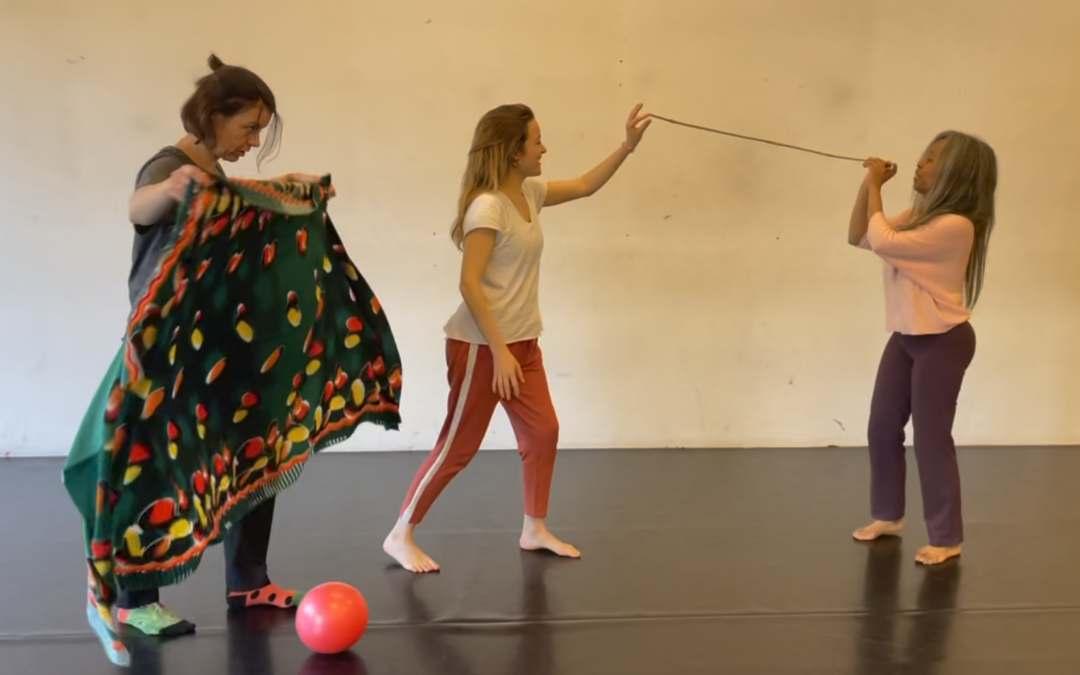
I offer weekly workshops in Brussels open to all women (as well as others specifically for new mothers—including pregnant women and those in the postpartum period). Each session follows a coherent and progressive process (walking, guided movements, circle choreography, breathing exercises, group games, etc.) in which movement helps develop body awareness and stimulate our vitality. The objectives can be varied: physical/toning, cognitive, emotional, or relational. They will be determined based on the target audience and the group dynamics.
In my workshops, I primarily use Laban Movement Analysis, Primitive Expression, and art therapy (incorporating drawing and writing with movement) to help women experience a unifying connection between body, heart, and mind—that is, a moment when physical movements, emotions, and ideas align toward a single intention. The goal is to help them: reduce stress, slow down, release tension, regulate their nervous system, break out of isolation, regain self-confidence, develop body awareness, find pleasure and joy, make the connection between emotions and movement, and feel themselves progressing on their path to empowerment and well-being.
I work in various settings and neighborhoods, using different formats. Everyone is welcome to come and experience a transformative journey through dance therapy.
References:
- Lesage, Benoit. Dance in the Therapeutic Process: Foundations, Tools, and Clinical Practice in Dance Therapy. Toulouse: Érès, 2021.
- Maillard, Catherine. I Dance, Therefore I Am: The Great Boom in Dance Therapy. Paris: Albin Michel, 2015.
- Schott-Billmann, France. When Dance Heals. Paris: Le Courrier du Livre, 2023.
- Vaysse, Jocelyne. Dance Therapy: History, Techniques, Theories. Paris: L’Harmattan, 2006.
- Vincent, Lucy. Get Your Brain Dancing. Paris: Odile Jacob.
- Klaperski-van der Wal, S., Skinner, J., Opacka-Juffry, J., & Pfeffer, K. “Dance and Stress Regulation: A Multidisciplinary Narrative Review.” Psychology of Sport and Exercise, 78, 102823 (May 2025). https://doi.org/10.1016/j.psychsport.2025.102823 PMID: 39922294.
- Strassel, J., Cherkin, D., Steuten, L., Sherman, K., & Vrijhoef, H. “A Systematic Review of the Evidence for the Effectiveness of Dance Therapy.” Alternative Therapies in Health and Medicine, 17, 50–59 (2012).
- American Dance Therapy Association (ADTA). Available at: https://www.adta.org/
- University of Sydney. “Dancing may be better than other exercise for improving mental health,” February 12, 2024. Available at: https://www.sydney.edu.au/news-opinion/news/2024/02/12/dancing-may-be-better-than-other-exercise-for-improving-mental-h.html