
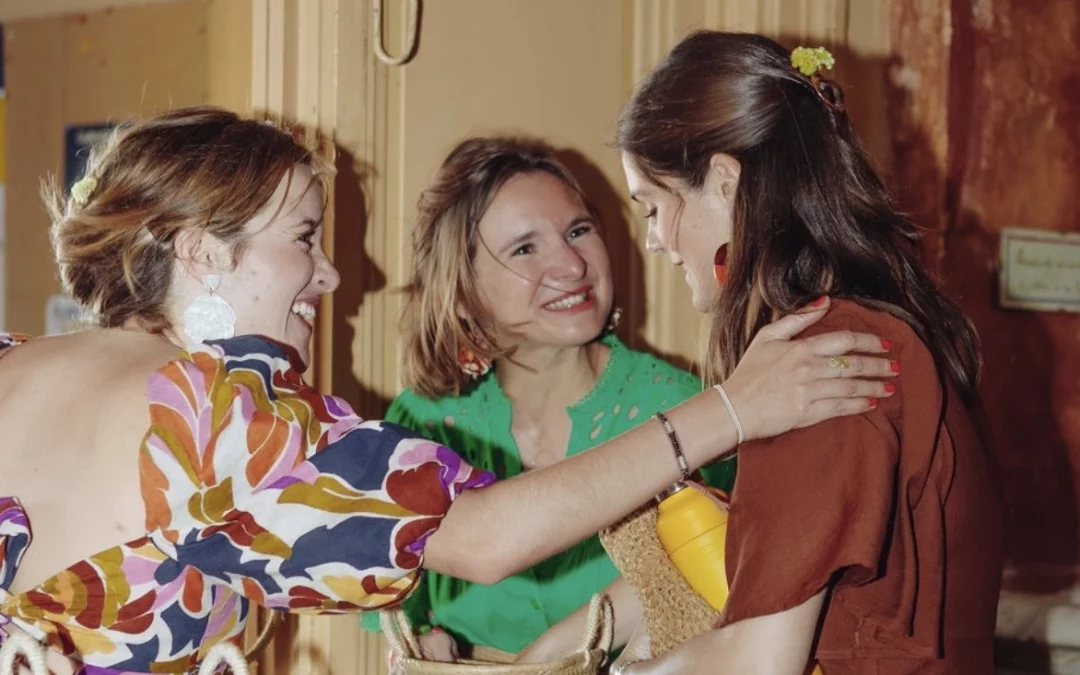
A key concept at She Moves is "sisterhood," defined as solidarity among women. Far from being a mere buzzword, it holds political, psychological, and anthropological relevance for women's emancipation.
A feminine noun from the Latin soror, "sister," the word sisterhood referred in the Middle Ages to a religious community of women, as Chloé Delaume notes in Sororité (2021). In the sixteenth century, sisterhood left the convent and came to designate, more broadly, a community of women bound by ties of quality, like sisters, an unshakeable bond from woman to woman. Although it has appeared in the dictionary for centuries, it was the feminist movements of the 1970s that truly brought it back to the fore.
A Political Lever Against Patriarchy
Sisterhood is a tool of power, a collective force, aimed at overturning patriarchal power. By breaking women's isolation, it turns individual struggles into collective struggles. From the suffragettes to mobilizations against sexist and sexual violence, and including the #MeToo movement, it is indeed solidarity among women — the pooling of voice, anger, and support — that has driven the most significant advances. A woman alone can be silenced but women united become a movement. The full political power of sisterhood does not merely bring people together but genuinely reshapes power dynamics and the patterns of living together with trust and care.
Trust in Oneself, Trust in Others
If sisterhood belongs to the political sphere, it also belongs to psychology. As Gloria Steinem points out, it is an ethic of life that rests above all on an inner revolution: that of a strengthened self-esteem. Empathy and openness are necessary conditions for entering into solidarity among women. But to be open to others, must one not already have a certain inner security, a certain self-confidence?
Accepting and valuing oneself is a condition for entering sisterhood. But the reverse is equally true! Through a caring approach, free of judgment or injunctions, this solidarity among women in turn helps restore self-confidence. Feeling seen, heard, and recognized by other women without judgment helps repair a part of self-esteem often damaged by years of contradictory injunctions. Coming together as women, in a safe space that invites one to reinhabit one's body and feelings, helps unlearn the internalized gaze of patriarchy — competition, the culture of performance — and to genuinely live this "inner revolution."
This intimate repair takes shape within a specific setting: the workshop — a space that can be read, from an anthropological perspective, as a genuine rite of passage.
Art Therapy and Rites of Passage: A Setting Conducive to the Emergence of Sisterhood
By entering the protected, creative space of the workshop, participants step into what anthropology calls a liminal space: each woman momentarily suspends her belonging to the ordinary world in order to freely explore her emotions, conflicts, or aspirations. Creation then becomes a way of moving through a psychic passage, often connected to life transitions (birth, bereavement, illness, adolescence...). In this symbolic, protected context, social hierarchies — age, professional status, origin, roles — are set aside, allowing a shared humanity to emerge.
Anthropologist Victor Turner calls this shared humanity communitas: a spontaneous, immediate, and concrete mode of social relation, carried by a strong sense of unity and equality among individuals. Transposed into a female context, this same ritual mechanism gives rise to a powerful sisterhood. This bond, temporary but intense, fosters moments of awareness, comfort, and psychic support during a personal transition — even moments of emotional release, and perhaps of inner healing.
Sisterhood at Work in She Moves Workshops
This is precisely the structure found in She Moves workshops, organized according to the three phases of the rite of passage defined by anthropologist Arnold Van Gennep: the separation phase, marking entry into a different space (welcome, settling in); the liminal phase, corresponding to the creative and symbolic work at the heart of the workshop; and aggregation, expressed through a time of verbalization and integration of the experience during the closing sharing circle.
From this structure emerges a genuine spirit of sisterhood, a source of both collective and personal transformation.
In Conclusion
Sisterhood thus offers three inseparable levels of understanding: political, by reshaping power dynamics and turning isolation into collective strength; psychological, by repairing self-esteem through mutual recognition; and anthropological, by reactivating, through contemporary rites of passage, that bond of communitas so essential to human cohesion.
At She Moves, it is this threefold dimension that we seek to bring to life in every workshop: sisterhood is never an abstract concept here, but an experience embodied and danced together — a path of emancipation that is political, deeply personal, and fully human all at once.
References
Delaume, Chloé. Sororité. Paris: Éditions Points, 2021.
Steinem, Gloria. Une révolution intérieure. Paris: Harpercollins Poche, 2025.
Turner, Victor. The Ritual Process: Structure and Anti-Structure. Chicago: Aldine Publishing, 1969.
Van Gennep, Arnold. The Rites of Passage. Translated by Monika B. Vizedom and Gabrielle L. Caffee. Chicago: University of Chicago Press, 1960 (reissued 2019, with a new introduction by David I. Kertzer).